


Great Basin Small Mammals and Climate Change
Small mammals help maintain healthy soils, spread seeds, ensure germination, and feed predators. As humans use natural resources and contribute to climate change, we must identify ways to conserve small mammal diversity. I am currently investigating how some small mammals, such as woodrats and ground squirrels, in the Great Basin of the western U.S. responded to past changes in vegetation and episodes of climate drying that are similar to what is happening now. Specifically, by analyzing small mammal bones deposited in caves over the past 16,000 years, we are testing ideas regarding (1) which types of small mammals are particularly sensitive to climate drying and (2) whether ongoing changes in climate or land use are a greater threat to these animals.


Climate Change and Extinction on Madagascar
Madagascar’s extensive endemic biodiversity is vulnerable, and climate drying is a potential threat to extant taxa that could have also driven the past extinction of elephant birds, pygmy hippos, and giant tortoises. Nonetheless, my work with nitrogen isotopes in ancient bone suggests that aridity around the time of past megafaunal extinctions was of little consequence to these animals as well as to extant lemurs, as they exploited relatively arid habitats earlier in the Holocene. Also, perhaps unexpectedly, archaeological 14C data indicate that people could have arrived millennia before these extinctions. My results implicate introduced livestock and dogs in the disappearance of Madagascar’s endemic large vertebrates. Modern survey and fecal isotope data indicate that dogs today consume endemic animals in protected forest, yet ancient bone isotope data give little evidence that ancient dogs ate extinct large herbivores. Instead, past facilitation of human-led hunts is most likely, and this was probably coupled with forest clearance that supported grazing livestock at the expense of endemic browsers. Thus, while climate drying today contributes to famine in southern Madagascar, aridification itself has not thus far posed an existential threat to wildlife.


Hixon, S., Phelps, L., Amano, N., Crossland, Z., Douglass, K., … & Fernandes, R. 2026. Changing habitat and rapid spread of introduced livestock across Madagascar. Proceedings of the Royal Society London B, 293.2079, 20260668.
Hixon, S. 2025. Mid-Holocene aridity recorded in pygmy hippo and giant tortoise bone from southwest Madagascar. Proceedings of the Royal Society London B, 292.2047, 20250493.
Hixon S., Domic A., Douglass K., Roberts P., Eccles L., Buckley M., Ivory S., Noe S., Kennett D. 2022. Cutmarked bone of drought-tolerant extinct megafauna deposited with traces of fire, human foraging, and introduced animals in SW Madagascar. Scientific Reports 12.1, 18504.
Hixon S., Curtis J., Brenner M., Douglass K., Domic A., Culleton B., Ivory S., Kennett D. 2021. Drought coincided with, but does not explain, Late Holocene megafauna extinctions in SW Madagascar. Climate 9.9, 138.
Hixon S., Douglass K., Crowley B., Rakotozafy L., Clark G., Anderson A., Haberle S., Ranaivoarisoa J., Buckley M., Fidiarisoa S., Mbola B., Kennett D. 2021. Late Holocene spread of pastoralism coincides with megafaunal extinction on Madagascar. Proceedings of the Royal Society B 288.1955, 20211204.
Hixon S., Elliott Smith E., Crowley B., Perry G., Randrianasy J., Ranaivoarisoa J.F., Kennett D., Newsome S. 2018. Nitrogen isotope (δ15N) patterns for amino acids in lemur bones are inconsistent with aridity driving megafaunal extinction in southwestern Madagascar. Journal of Quaternary Science 33.8, 958-968.
Learning More from Ancient Bone
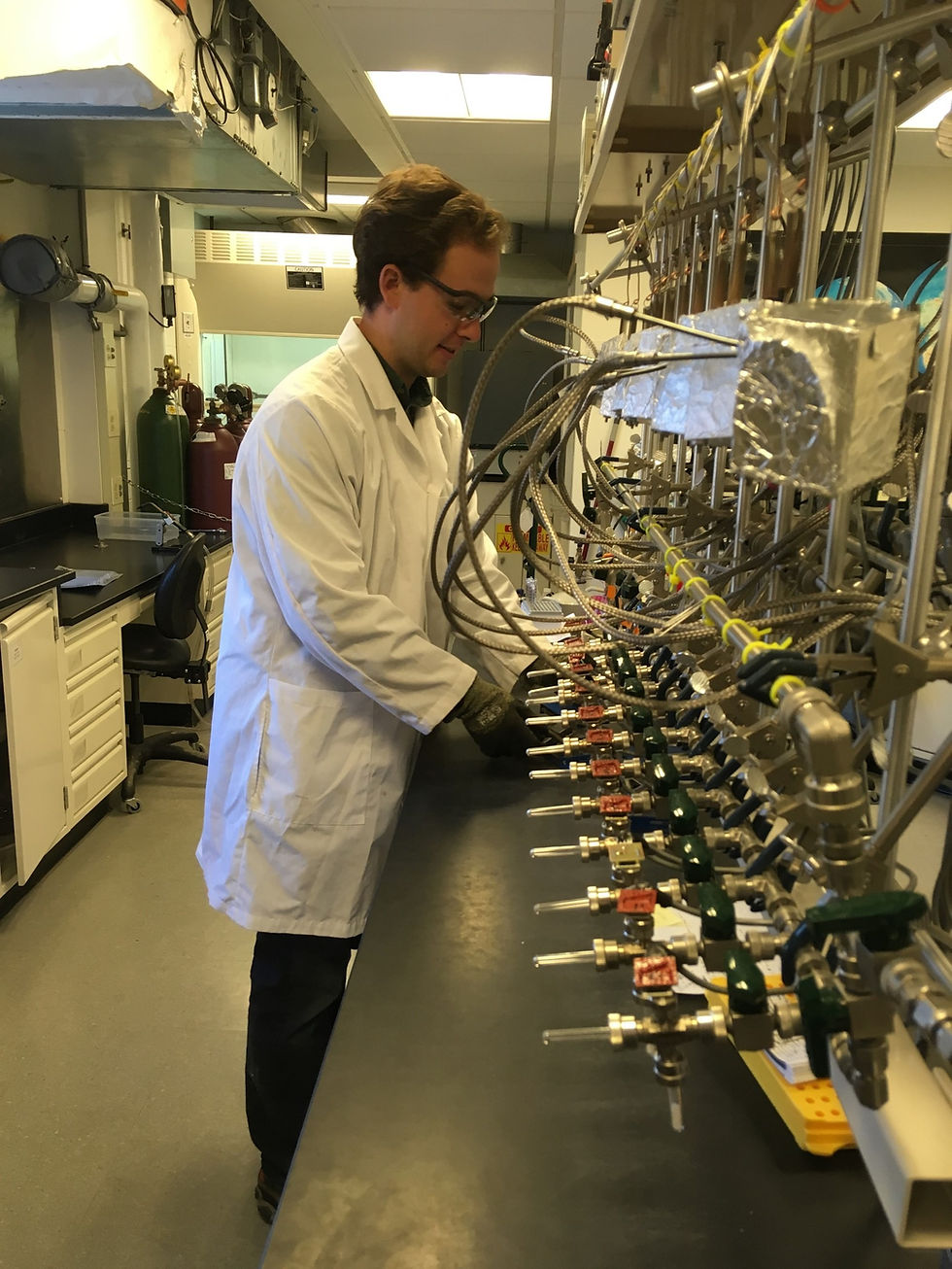
Given that the aridity signal in nitrogen isotope (δ15N) values can be attenuated in bulk consumer tissue according to diet quality, I turned to amino acid (AA) specific δ15N analysis in plants across an aridity gradient to test the idea that certain AAs carry a signal sensitive to soil nitrogen cycling that is not attenuated by plant and consumer metabolism. To more efficiently extract AAs from subfossil bones, I tested simplified protocols for using Fourier transform infrared spectroscopy to quickly screen bone for protein preservation.


Hixon, S., Vassão, D. G., Fernandes, R., Ganzhorn, J. U., Garbaras, A., … & Larsen, T. 2026. Sensitivity of foliar amino acid δ15N values to lignin content and moisture availability across an aridity gradient in southern Madagascar. Phytochemistry, 253, 115067. https://doi.org/10.1016/j.phytochem.2026.115067
Hixon, S., Roberts, R., Rodríguez-Varela, R., Götherström, A., Rossoni-Notter, E., Notter, O., … & Fernandes R. 2024. Expedient Bayesian prediction of subfossil bone protein content using portable ATR-FTIR data. Quaternary International 694, 1-12. https://doi.org/10.1016/j.quaint.2024.05.002


Increasing Data Availability
Spatially-explicit analyses of natural abundance stable isotope data are useful for answering a variety of paleo and modern ecological questions. For example, on Madagascar, characterizing modern spatial gradients in foliar stable carbon isotope values across an aridity gradient has helped to convert isotopic data from animal (e.g., extinct pygmy hippo and introduced cattle) tissues into more relevant estimates of the fractions of different plant types consumed. In the Americas, compilations of isotopic data from ancient human bone help to document the past spread of maize agriculture.
Billings, T. N., Scott, E., Cocozza, C., Hixon, S., Boivin, N., Roberts, P., ... & Fernandes, R. 2025. The North American Repository for archaeological Isotopes. Scientific Data 12.1, 50. https://doi.org/10.1038/s41597-024-04175-2
Hixon, S., Fernandes, R., Andriamahaihavana, A. et al. 2024. Introducing IsoMad, a compilation of isotopic datasets for Madagascar. Scientific Data 11.1, 857. https://doi.org/10.1038/s41597-024-03705-2
Ebert, C. E., Hixon, S. W., Buckley, G. M., George, R. J., Pacheco-Fores, S. I., Palomo, J. M., ... & Kennett, D. J. 2024. The Caribbean and Mesoamerica Biogeochemical Isotope Overview (CAMBIO). Scientific Data 11.1, 349. https://doi.org/10.1038/s41597-024-03167-6
Rapa Nui Environmental History
The past deforestation of Rapa Nui (Easter Island) to fuel a statue building mania is often reported as the quintessential example of human capacity for destructive short-sightedness. However, by evaluating physical traces and the feasibility of different stone monument (“pukao”) transport methods, we concluded that monument transport did not require large groups of people and was not necessarily linked to deforestation. The societal “collapse” on this island followed centuries of survival in a marginal environment and more likely followed from the slavery and disease that came with European contact.


Hixon S., DiNapoli, R.J., Hunt T.L., Lipo C.P. 2019. Historical accounts of freshwater use on Rapa Nui (Easter Island). Journal of the Polynesian Society 129.2, 163-189. https://www.jstor.org/stable/26857339
Hixon S., Lipo C.P., McMorran B., Hunt T.L. 2018. The colossal hats (pukao) of monumental statues: an analysis of pukao variability on Rapa Nui (Easter Island). Journal of Archaeological Science 100, 148-157. https://doi.org/10.1016/j.jas.2018.04.011
Hixon S., Lipo C., Hunt T., Lee C. 2018. Using structure from motion mapping to record and analyze details of the colossal hats (pukao) of monumental statues on Rapa Nui (Easter Island). Advances in Archaeological Practice 6.1, 42-57. https://doi.org/10.1017/aap.2017.28